


 Pay my balance


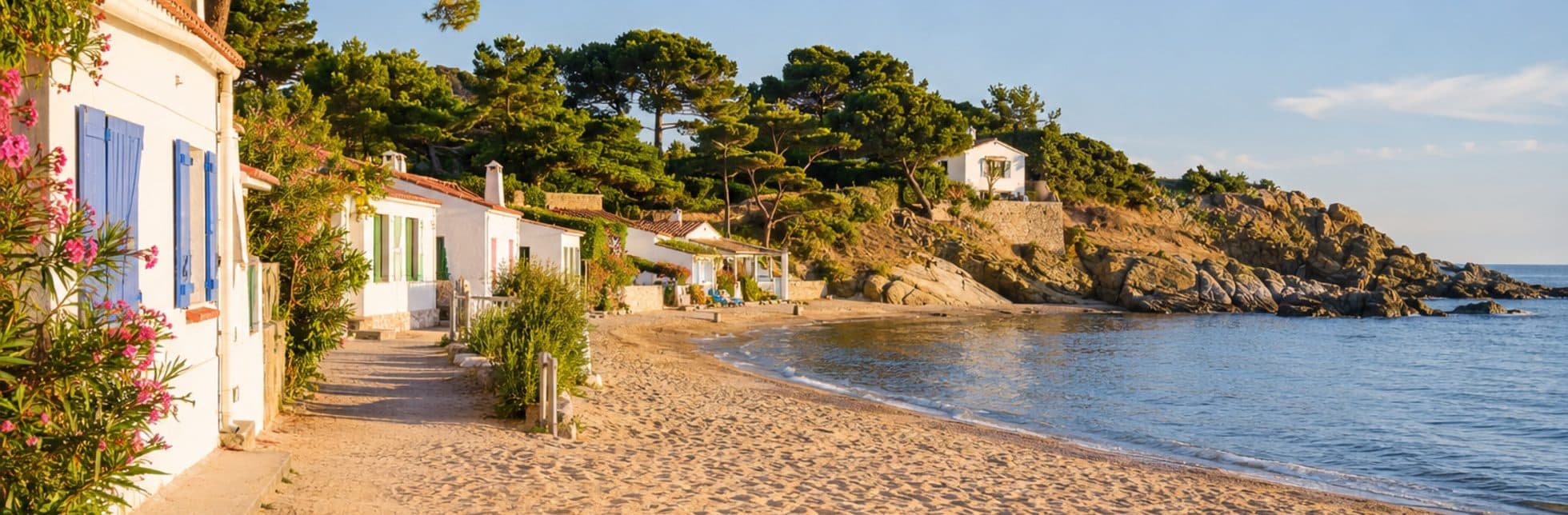
The Racou beach closes Argelès-sur-Mer to the south, where the sand gives way to the first cliffs of the Côte Vermeille. Its small white houses, its sandy paths closed to cars and its coves make it a place apart on the Catalan coast. Here is its history, its activities, its tables and practical information to prepare your visit from our campsite in Argelès-sur-Mer, Le Méditerranée.
Racou at a glance
- Location: southern end of the resort, at the junction of the sandy coast and the rocky coast.
- Atmosphere: a hamlet of small houses separated by sandy paths, inaccessible to cars.
- Swimming: supervised at lifeguard station 6 from late May to late September.
- On site: tapas bars, fish restaurants, oyster bar, crêperie and wine cellar.
- From the shore: coastal path towards Collioure and the point’s orientation table.
“Racho”, a watering hole on the way to Collioure
Le Racou appears in official texts as early as the 16th century, under the name “Racho”. The place was then known for its watering hole, located on the path leading to Collioure, long before the current Corniche road. The word comes from Catalan and means “the nook”, which describes this cove closed off by rocks quite well.
For a long time, there were only a few wooden cabins for bathers. The first permanent constructions appeared in the 1930s, when the town hall rented plots to the poorest families; these were sold after the Second World War. The Germans, who feared a landing on the Catalan coast, had meanwhile bristled the shoreline with iron crossbars and submerged concrete blocks.
In the 1950s and 1960s, the “beach train” brought more visitors every summer. Only five or six families lived there year-round at the time, with two shops open continuously: the Colomine family grocery store and the bar-restaurant La Caravelle. Today, about a hundred families reside there year-round and the site has been the subject of a rehabilitation program led by the Conservatoire du Littoral, which put a stop to real estate projects.
Good to know: this history explains the shape of the hamlet. The plots rented and then sold created modest, tightly packed houses, without seafront alignment or apartment buildings. This is what distinguishes it from other seaside sectors of Argelès-sur-Mer, built later and designed for cars.
Sandy alleys where cars do not enter
The small houses are separated by sandy and green alleys, closed to traffic. Children move alone from one house to another, on the scale of this village of sand. In front of the doors, residents tend to their small gardens and leave kayaks and paddles waiting for the next trip to the coves.
The day ends with a discreet handover. Around 6 PM, vacationers fold their towels and the Argelès locals arrive after work, often with their families. A game of beach volleyball, a swim at sunset, then an impromptu aperitif on the sand: this is the moment when the neighborhood becomes that of the residents again.
Swimming, snorkeling and coastal path
Here, two coastlines meet: sand on one side, rocks on the other. This position allows you to combine swimming and exploring small coves, with fins and snorkel on your nose. Paddleboarding and spearfishing also have their fans, and swimming is supervised in season, as on the other beaches of Argelès-sur-Mer.
To get a higher view, the coastal path starts at the end of the sand. A five-minute climb is enough to reach the orientation table at Pointe du Racou, with a view of the beach, the port and the coast as far as the north of the resort. Continuing south, the path runs along the Porteils rocks, the first schistose cliffs of the Catalan rocky coast, then reaches Ouille beach 3 km away, at the gates of Collioure.
Our tips: bring water shoes for the rocky part, where pebbles make getting into the water less comfortable. Set off early on the coastal path, as shade is rare and the climb is in full sun. Finally, keep your mask and snorkel in your bag: the bottom of the coves can be discovered just a few meters from the edge.
The tables of Racou, from tapas bars to grilled fish
The hamlet concentrates a handful of addresses, from fishing cuisine to takeaway snacks:
- Menja Aqui has been serving tapas on the sand since 1998 and requires a reservation.
- Le Menje Écaille cultives the look of a bohemian camp, furnished with flea market finds.
- La Table du Racou offers home-made cuisine: grilled local catch of the day, seafood and zarzuela.
- Les Terrasses du Racou works a traditional Mediterranean menu next to the sand.
- Le Cactus Bleu and Racou Beach Snack provide quick service, on-site or to take away.
Coming to Racou from our campsite
The hamlet is easily reached from our estate, 6 km away via Avenue de Charlemagne. Here is the information to keep on hand before leaving:
- Address: Le Racou, 66700 Argelès-sur-Mer.
- Parking: Port parking and Sardane parking, as the hamlet’s alleys are closed to cars.
- In high season: favor cycling or walking, as the area saturates quickly.
- Supervised swimming: station 6, from 10:30 AM to 6 PM from late May to late September, until 7 PM in July and August.
- Dogs: prohibited on the beach, allowed on a leash at the fishermen’s parking lot and at the Mas Larrieu nature reserve.
Route from Le Méditerranée campsite to Racou beach:
Are you preparing your holidays on the Côte Vermeille and Racou is already on your list? Our season is short and family accommodations go first: book directly with Le Méditerranée campsite to enjoy the best guaranteed rate and free cancellation up to 5 days before arrival, excluding summer holidays.
Your questions about Racou
What does the word “Racou” mean?
“Racou” means “the nook” in Catalan, and the name describes the small cove closed off by the rocky coast. The first written mentions of the place, spelled “Racho”, date back to the 16th century, at the time when its watering hole served travelers heading to Collioure.
Is Racou beach supervised?
Racou beach is supervised at lifeguard station 6, from late May to late September, from 10:30 AM to 6 PM. In July and August, supervision is extended until 7 PM, as at the six stations in the municipality. These dates change from year to year: check them with the tourist office before your visit.
Do cars circulate in the alleys?
No, cars do not circulate in the sandy alleys that separate the small houses. Parking is available beforehand, at the Port parking lot or the Sardane parking lot, then the visit continues on foot. In July and August, cycling remains the easiest way to reach the hamlet from the resort.
Are dogs allowed on Racou beach?
No, dogs are not allowed on this beach. In Argelès-sur-Mer, only two sectors welcome them: the fishermen’s parking lot, south of the dike, and the Mas Larrieu nature reserve. In these two zones, they must remain on a leash, and their swimming is prohibited from 9:30 AM to 7:30 PM.